Alejandro Melian · Game design
Shipped · Blink Shot · Steam · co-operative third person shooter

Bugs ’N
Guns

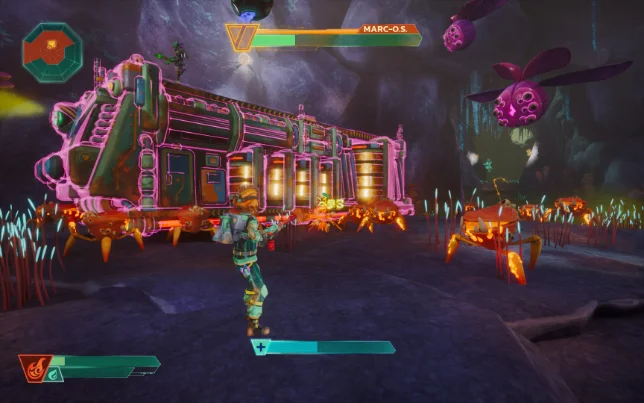
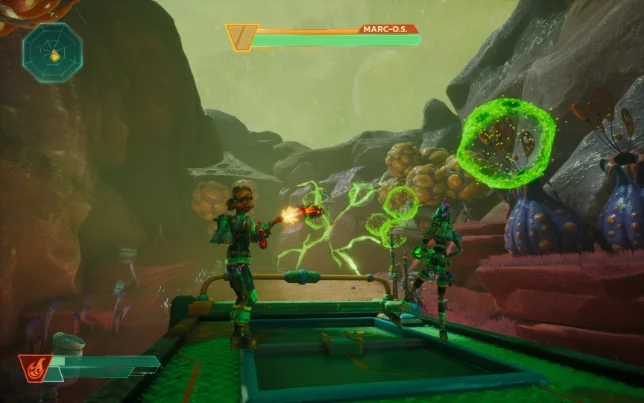
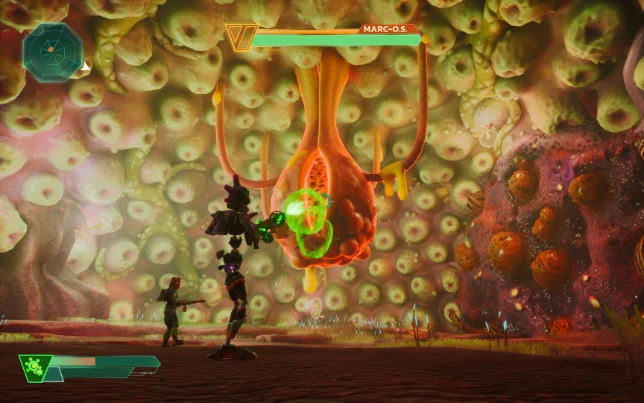
Bugs N' Guns is a cooperative third person shooter. Player will need to combine their weapons firepower to eliminate enemies and obstacles as players try to protect a train called MARC - OS from hostile flora and fauna.

01

Trailer

Two players, one train
Trailer · ReleasedWatch on YouTube ↗
03

Core loop

01
Escort
MARC-OS keeps moving. The train is the thing you are defending, so position is always measured against it.
02
Combine fire
Weapons are read together rather than alone — two players pooling firepower is the intended answer to a threat.
03
Clear
Enemies and obstacles both stand between the train and the next stretch of track. Both have to come down.
04

What I owned

Vision & Production: Established the game's foundational vision and directed end-to-end production from Alpha to Beta, managing a cross-functional team of 16 artists, programmers, and designers.

Systems & Mechanics: Conceptualized, prototyped, and implemented core gameplay systems, including the four distinct elemental weapons and dynamic enemy AI behaviors.

Holistic Design: Owned the comprehensive design pipeline, driving gameplay loops, level architecture, and narrative design to ensure a cohesive player experience.

Original visionWeapon designEnemy AI behaviourGameplay designLevel designNarrative designProduction, alpha → beta
Discipline
Vision · weapons · enemy AI · production
Platform
PC — Steam
State
Released
Studio
Blink Shot
Team
16 — artists, programmers, designers
05

Design problems

Co-op that needs two people
The shooting is built so a single player cannot brute-force an encounter — combined firepower is the mechanic, not a bonus.
A defence target that moves
Protecting a train instead of a point means the safe side of a fight changes as it travels.
Hostile flora and fauna
Enemies come from the environment itself, which ties threat placement to level layout rather than to spawn tables.
Four elements that stay distinct
Each weapon needed its own shooting behaviour and pattern, and had to stay readable once combined with any of the other three.
Enemies that force the combination
Flying enemies can only be dropped by combined shots, which is the clearest way to make co-operation a requirement rather than an optimisation.
Aim assist we had to build ourselves
Off-the-shelf assist did not fit four projectile patterns and climbing enemies, so the system was bespoke.
06

Systems in the shipped game

~/projects/bugs-n-guns
Elemental weapons
  • Four elements, each with its own shooting behaviour and projectile pattern
  • Multiple elemental combinations between players
  • Bespoke aim assist system, built in-house
Enemies
  • Flying enemies that had to be brought down with combined shots
  • Ground enemies that could walk and climb
  • Turrets firing homing projectiles
  • Enemy AI behaviours and concepts defined per family
Level content
  • Multiple biomes
  • Puzzles and platforming sections between engagements
  • MARC-OS as the escorted objective across the route
Presentation & structure
  • Voice narrated narrative
  • Third person co-operative shooting
  • Hostile flora and fauna as the enemy family
07

Team & pipeline

16 people · in-office · Trello + Notion

For Bugs n Guns, our in-office pipeline was built around structured communication, rigorous milestone tracking, and maintaining a single source of truth. To protect the team's focus and prevent scope creep, I established a clear departmental hierarchy.

Each team kicked off the day with a localized morning sync to align on actionable tasks via Trello, while all overarching systems and specifications were strictly documented in our central Notion Game Design Document (GDD). To ensure macro-alignment without derailing individual contributors, I met directly with the area leads weekly.

We managed our overall production timeline through monthly sprint reviews against our Gantt charts, complemented by end-of-week progress check-ins. To maintain a unified vision across the studio, I also instituted bi-daily full-team playtests, guaranteeing that everyone consistently experienced the latest builds and understood exactly how their daily tasks integrated into the final product.

08

Postmortem

What playtesting and the retro told us

What worked

Core combat & movement
The fluid movement mechanics and the elemental combination system were highly praised during playtesting, establishing themselves as the strongest and most engaging pillars of the game.

Product & gameplay insights

Player agency vs. escort fatigue
Relying exclusively on an escort-driven core loop negatively impacted player agency, with feedback indicating that players felt “dragged” rather than empowered. Future iterations need broader objective variety.
Puzzle clarity & telegraphing
Playtesting revealed a need to expand elemental variety and improve readability in puzzle-combat. Specifically, the flying enemies requiring exact elemental combinations lacked clear telegraphing, creating unintended friction and confusion for players.

Cross-disciplinary pipeline

Tooling & variable control
A critical bottleneck emerged post-implementation. Systems were built in a way that locked variables behind the code, creating a dependency on programming for minor design tweaks and balance passes.
Upfront system documentation
To resolve the tooling issue in the future, the programming team requires more highly detailed, specific system requirements from design during the initial handover. This will allow engineering to proactively build open, flexible tools for the design team.

Team alignment & task management

Accountability
Internal reviews highlighted friction regarding task management. Moving forward, the production pipeline requires tighter oversight and stricter adherence to task tracking to ensure all team members remain aligned and accountable for their daily deliverables.